

While legitimate archaeologists spend just one month a year painstakingly unearthing Armenia’s past, illicit treasure hunters are pillaging it year-round.
The primary battleground for this cultural war is the Aragatsotn Province, where looters strip the country’s subsoil with near-total impunity. Despite fifty-five reported cases of treasure hunting to law enforcement between 2023 and 2026, not a single criminal proceeding has led to a conviction or an accused individual. In Armenia, plundering history has become an almost entirely unpunished crime, as cases languish under investigation for years, never seeing the inside of a courtroom.
A Collision of Two Worlds
The stark reality of this crisis hit home recently at the Shamiram Iron Age Settlement and Necropolis in Aragatsotn. For the past three years, Varduhi Melikyan, a resolute researcher at the Institute of Archaeology and Ethnography (IAE), has been uncovering the secrets of this exceptional, multi-layered complex. Spanning sixty hectares across isolated mountain slopes, gorges, and high plateaus, the ancient site sits exposed on an open, rocky plateau, shielded only by thin stone slabs and a shallow layer of soil.
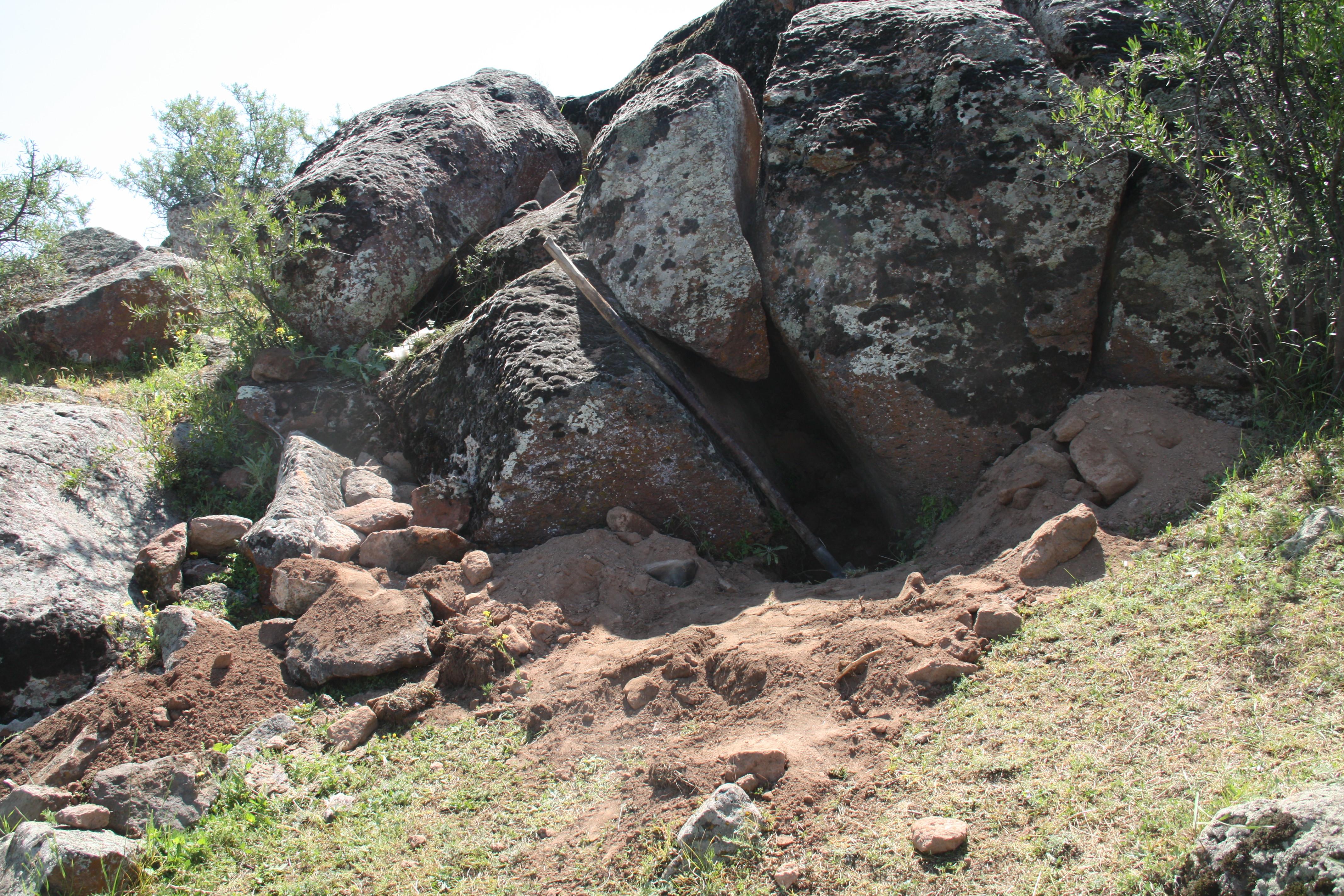
From May 26 to June 25, Melikyan led the Armenian side of a joint Armenian-Italian archaeological expedition. But they weren’t alone. While the team carefully brushed away centuries of dirt to map out a landscape of continuous human habitation stretching from the Bronze Age through the medieval eras, looters were operating right alongside them under the cover of darkness.
One morning, the expedition arrived to find stone fragments completely displaced near their active excavation zone. The treasure hunters had been caught in the act.
“They had dug as deep as possible with a shovel into a rock formation—a rock that already had a fissure—and then left the shovel inside the crack before fleeing,” Melikyan recalls.
The team immediately alerted the site supervisor, who documented the freshly disturbed earth. Yet, the official state response highlights the systemic sluggishness of protecting these monuments. Sometime later, the head of the local Shamiram community simply reported receiving a notice from Armenia’s Ministry of Education, Science, Culture and Sports (MESCS), asking that the site be “monitored.”
The Ghost Excavators
For Melikyan, the brazenness of the shovel left in the rock was a disturbing milestone—the first time her team had clashed so directly with looters while actively working. Yet, the shadows of treasure hunters have long loomed over Shamiram.
Just a year earlier, the expedition arrived to find the site already ravaged before they could even pitch their tents. The earth surrounding an ancient sacrificial altar had been completely turned over. Worse, looters had tunneled directly beneath the site’s fortress wall, triggering a catastrophic collapse of the historic stones. To this day, Melikyan has received no updates from law enforcement on whether anyone was ever identified or prosecuted for the destruction.
What these looters are dismantling is an invaluable gateway to antiquity. Looters specifically hunt for the site’s ancient tombs because during the pagan era, elites were interred with their most valuable possessions.
“An archaeologist might excavate ten burial sites without finding anything of value to study,” Melikyan explains. “But by excavating a single tomb, treasure hunters can remove highly valuable materials, thereby depriving archaeologists of the opportunity to conduct a scientific study of the period.”
The tragedy of this unregulated plunder is underscored by what scientists can achieve when they beat the looters to the dig. The IAE hailed the excavation of “Burial Site No. 3” as the crown jewel of the latest season. Safe from the looters’ shovels, the monumental Late Bronze Age tomb revealed concentric stone circles guarding a central stone chamber containing rich grave goods, bronze weapons, obsidian arrowheads, and the skeleton of a ritually sacrificed horse—providing unprecedented data on ancient local elites and pagan burial rites.
Why Aragatsotn?
The epicenter of this crisis remains the Aragatsotn Province. Arsen Bobokhyan, Director of the IAE, explains that two factors make the region a prime target for illicit diggers:
- Unmatched Density: Aragatsotn is the province richest in historical monuments in Armenia.
- Barren Landscape: The low vegetation cover leaves ancient structures entirely visible on the ground surface, acting as an open map for criminals.
Armed with modern technology, treasure-hunting syndicates systematically target burial grounds, abandoned settlements, and the vulnerable perimeters of ancient fortresses. While the entire province is under siege, two sprawling complexes bear the brunt of the onslaught: the Shamiram Settlement and the Aghtamir Fortress Complex in the village of Voskevaz.
Aghtamir is a colossal ninety-hectare monument cluster comprising an ancient settlement, a burial field, a cemetery, and unique cave dwellings. Official records from the MESCS reveal that not a single legitimate archaeological expedition worked at Aghtamir between 2023 and 2026. Instead, looters had the site entirely to themselves, striking it with unauthorized excavations and heavy earth-moving activities consecutively over multiple years.
The consequences of this abandonment turned catastrophic during an illegal excavation that severely damaged underground burial chambers, displaced historic soil, and turned a protected ancient zone into a literal garbage dump. However, the looters also hit a major archaeological jackpot, unearthing five phallic-shaped stone stelae tentatively dated to the second half of the 2nd millennium BC.
Because treasure hunters had already compromised the soil, a rescue team led by Professor Ashot Piliposyan scrambled for emergency authorization to complete the disrupted dig. They managed to salvage a total of eight phallic stone objects and two rare Urartian ceramic items, transferring them to the Metsamor Historical-Archaeological Reserve-Museum for permanent protection. It was a rare, bittersweet victory for science—but one that only occurred because looters had broken ground first.
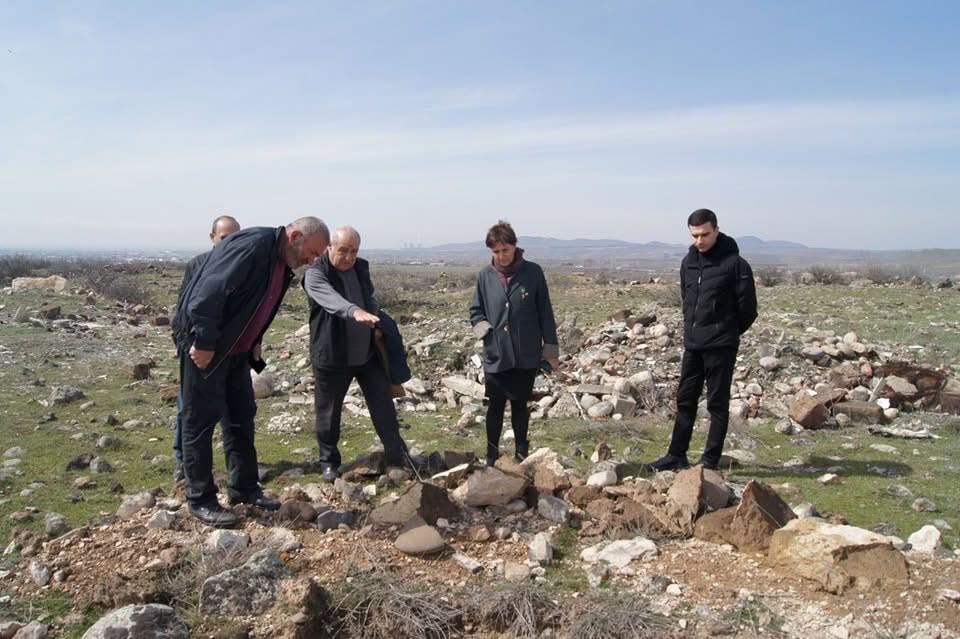
Prof. Piliposyan inspects site dug up by treasure hunters
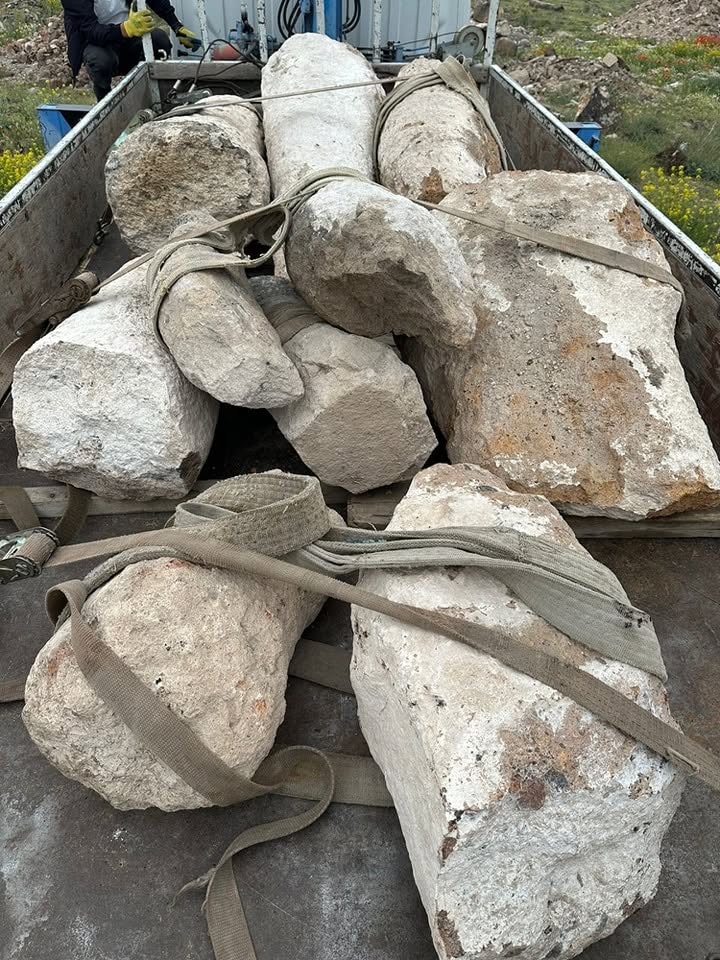
Phallic objects unearthed by the looters
Helicopters vs. Foot Patrols: A Rigged War
Armenia’s archaeologists are facing deep frustration. Researchers are outraged not only by the systemic destruction of ancient history but by a bizarre, localized disrespect: when scientists return to major archaeological sites near villages to resume their annual digs, they frequently find the previous year’s trenches filled with household garbage. This leaves the state’s cultural preservation ecosystem caught in a strange paradox, forcing the SNCO (State Non-Commercial Organization) to engage in reactionary excavations just to rescue items from compromised dirt instead of focusing on long-term preservation.
The technological gap between the state and the criminals highlights why the subsoil is being looted with complete impunity. Archaeologists report that modern treasure-hunting syndicates use sophisticated technology, with high-end groups utilizing helicopters to rapidly scout and hop between remote, isolated plateaus. Meanwhile, for years, the site custodians and overseers complained that they lacked even a basic vehicle to patrol the vast, rugged landscapes under their care, forcing them to conduct patrols on foot.
The state insists it is trying to change its strategy. Armen Hovhannisyan, Director of the Service for the Protection of Historical-Cultural Museum-Reserves and Historical Environment SNCO, stated that regional branches are now being equipped with vehicles, work tools, and unmanned aerial vehicles (drones). However, the sheer volume of territory remains overwhelming. “A single monument warden oversees, on average, three to thirteen communities—depending on the number of registered monuments, distances, and terrain accessibility,” Hovhannisyan notes.
Furthermore, the high-tech promises of 24/7 video surveillance rapidly fall apart when facing Armenia’s rugged backcountry. Davit Danielyan, an advisor to the director of the SNCO, clarifies that security cameras are almost exclusively installed at monuments located within or near developed settlements—simply because those are the only places where infrastructure exists. Remote fortresses and burial grounds—the exact sites targeted most frequently, including Shamiram and Aghtamir—lack any video surveillance systems whatsoever.
Bringing power to these ancient sites has proven to be an engineering and financial nightmare. At one remote site, a solar power unit was installed to run a security camera, but it failed to generate enough consistent electricity, leaving the camera dead. At another, the state partnered with the Electric Networks of Armenia (ENA) to build a dedicated electrical substation just to power surveillance equipment. Such measures entail enormous financial costs and cannot be implemented on a wide scale.
Faced with an inadequate security grid, the SNCO has chosen the path of public education. Since 2015, they have been visiting schools to systematically dispel a common myth among children that treasures are buried at historical monument sites, hoping to shape their mindset and turn them into the future guardians of the monuments.
The Black-Market Boom and the State’s Heavy Price
For Arsen Bobokhyan, curbing the allure of the black market requires a dual strategy: dismantling the romantic allure of looting and introducing devastating financial penalties. “This should begin in kindergarten, by instilling in children a sense of care for our heritage,” Bobokhyan argues. “Treasure hunters must face real consequences—whether through prosecution under the relevant laws or by paying fines amounting to thousands of times the minimum wage.”
While the state struggles to find the funds for simple field cameras, a shadow economy of looted history is quietly thriving right in front of them. Experts note that private individuals in Armenia frequently amass collections far more valuable than those held by the national History Museum, with illicit artifacts routinely surfacing on open online marketplaces and social media pages.
The staggering irony of Armenia’s underfunded field security was put on full display when the Government of Armenia allocated a massive AMD175.360 million from the state budget for a single acquisition: purchasing a medieval wooden door from an international auction house in London. Reports suggest the priceless door originally belonged to Armenia’s own Haghpat Monastery. How it was smuggled out of the country, circulated through global black markets, and ultimately sold back to its homeland at an astronomical premium remains completely unknown. It stands as a warning: as long as Armenia refuses to fund the protection of its soil, it will continue to buy back its own history from international auction blocks—one stolen piece at a time.
The New Sacred Target
The calculated plunder of Armenia’s subsoil has also expanded into a brazen raid on the divine, with treasure hunters targeting active and historic churches with unprecedented intensity. Out of nine recorded thefts of religious artifacts recently, three strikes targeted major monastic complexes.
The losses hit key spiritual hubs:
- Hovhannavank Monastic Complex: Located in the village of Ohanavan within the heavily targeted Aragatsotn Province, where historic crosses were stripped from the site.
- Saint Hovhannes Church: Situated in the city of Artashat (Ararat Province), which suffered a matching targeted theft of its sacred crosses.
The escalating crisis forced a rare intervention by law enforcement. The Operational Management Center of the Ministry of Internal Affairs revealed a pattern of coordinated thefts spanning churches and remote chapels across the country. Items stolen included crosses, chalices, and silver vessels used to hold holy chrism (myron).
The investigation led police to intercept and arrest two men, aged 30 and 38, from the city of Armavir, near the village of Shahumyan on the Yerevan-Yeraskh road. While the arrest stopped the duo’s immediate spree, it exposed the efficiency of the black-market pipeline: the men had already successfully sold off a sizable portion of the stolen items, while the rest were found in their vehicle. Yet, historically, these cases follow a predictable script—the files either fail to navigate the bureaucracy to reach a courtroom, or the perpetrators walk away without serving a single day of a prison sentence.
The Irreversible Void
When the state is asked to put a price tag on the destruction of its own past, the answer is chilling. The SNCO delivered a definitive verdict on the damage: it is mathematically impossible to calculate. According to formal expert assessments, the loss of these smashed monuments is entirely irreversible. Immovable ancient structures, along with the fragile dirt layers contained within them, cannot be rebuilt or restored, meaning the extent of the damage cannot be expressed in monetary terms.
For scientists, this structural destruction hits right at the heart of historical truth. “The disruption of stratigraphy represents an irreversible loss for an archaeologist,” Bobokhyan warns. When a looter rips an artifact out of the ground, they permanently destroy the distinct layers of earth that tell scientists exactly when, how, and why an ancient society lived. Without those undisturbed layers, the timeline of human history is wiped clean.
A Lone Docket in a Sea of Silence
The numbers behind this systemic failure speak for themselves. Data provided to Hetq lays bare the absolute gridlock within the judicial system. Out of the 55 formally reported cases, regional divisions of the Investigative Committee initiated criminal cases for fewer than half (21 cases). Of those 21 primary criminal cases, the geographic breakdown reveals a targeted onslaught on specific regions: 14 occurred in the Aragatsotn Province, three in the Vayots Dzor Province, and one case each was recorded in the Tavush, Syunik, Kotayk, and Armavir provinces.
The Prosecutor General’s Office confirmed that across these primary cases, not a single person holds the legal status of “accused.” Instead, the system swallows the files whole. Administrative proceedings were launched in just two instances, while 32 cases remain trapped in stagnant investigations. Even when a case does close, it rarely brings justice; an illegal excavation at the historic Vorotnaberd Fortress in Syunik was quietly terminated after investigators bizarrely concluded that “no crime had been committed.” The absolute lack of answers strongly points to a damning reality: no actual investigative work has been conducted on these cases, some of which were opened over four years ago.
Amid this sea of silence, a singular, fragile piece of justice has finally squeaked into the judicial system. Gagik Gevorgyan, a senior official within the Investigative Committee’s Main Department for Special Assignments, confirmed that just one investigation into the sweeping wave of treasure hunting has been concluded and sent to court accompanied by a formal accusation.
But rather than targeting the sprawling, helicopter-riding syndicates stripping the remote mountains, this case centers on an almost comical blunder in the heart of the capital city. The incident took place at the Biainili (Urartian) Tomb Museum on Arshakunyats Avenue in Yerevan. According to the formal accusation, Narek Khachatryan and Sasun Hovhannisyan broke the lock on the museum’s door to execute a midnight heist. Their targets were highly symbolic treasures dating back to the 8th century BC: a fragment of an ancient horse bit, an intricate ancient seal, and a ceremonial Urartian bowl.
The looters fled into the night, believing they had successfully stolen priceless remnants of the foundational Biainili civilization. There was only one problem: the items they had meticulously targeted were museum replicas. Both stand charged with the attempted covert theft of an object possessing significant historical and cultural value committed by a group.
Yet, even as this single trial inches forward, it highlights the state’s profound avoidance of the larger crisis. When pressed by Hetq, neither Armenia’s Prosecutor General’s Office nor the Investigative Committee would answer a fundamental question: has the state ever calculated the actual physical and structural damage inflicted upon the ancient monuments themselves?
A careful assessment reveals that equipping archaeological sites with basic security technology is vastly more cost-effective than purchasing stolen artifacts back from global auctions. The looting of historical artifacts and recurring acts of vandalism are not ordinary property crimes—they are calculated strikes against a nation’s collective memory and cultural identity. Until the law catches up to the shovels, Armenia’s subsoil will continue to be hollowed out, leaving future generations to look at empty trenches where their history used to be.
Photos from the website of the Institute of Archaeology and Ethnography; From the Facebook page of the “Service for the Protection of Historical-Cultural Museum-Reserves and Historical Environment” SNCO; and from the archive of Varduhi Melikyan
If you found a typo you can notify us by selecting the text area and pressing CTRL+Enter