


By BERGE JOLOLIAN
Armenia cannot choose its neighbors. But must its neighbors—and more distant powers—be allowed to choose Armenia’s future?
Geography demands realism. A small country cannot disregard larger powers, avoid every compromise, or expect foreign governments to place its interests above their own. Yet realism becomes fatalism when it assumes that Armenia’s only choice is deciding whom to obey.
The challenge is to accommodate powerful neighbors without surrendering the freedom to choose. That requires more than diplomatic skill. It requires reliable alternatives—in energy, trade, security, and international partnerships—and Armenian institutions capable of using them.
These are not abstract concerns. They affect the security of families, the prospects of businesses, and whether people can plan a future in Armenia.
Armenia’s task is not to escape geography. It is to build the strength to negotiate within it.
History Offers Lessons, Not Guarantees
An ancient coin captures the dilemma. A bronze coin attributed to Tigranes IV and Queen Erato, dated approximately 2 BC–AD 1, pairs the rulers’ portraits with Mount Ararat and the Greek inscription Philocaesar— “Friend of Caesar.”
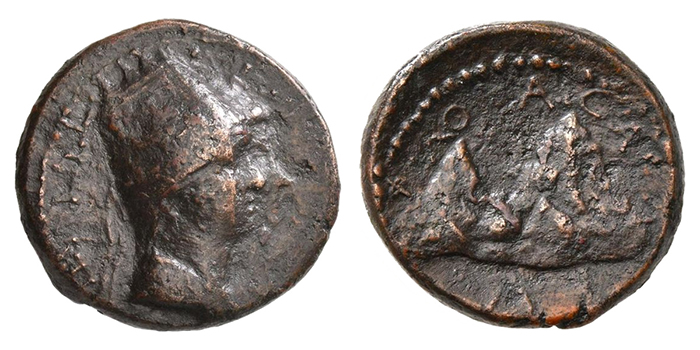
The coin is associated with Tigranes’s agreement to receive his crown from Augustus, acknowledging Roman supremacy. It therefore illustrates Armenian rulership under imperial pressure, not unrestricted independence. Its significance lies in the dilemma it reveals: how much accommodation preserves a state, and when does it place that state’s future in another power’s hands?
Centuries later, the Bagratuni dynasty restored Armenian kingship with recognition from both the Abbasid caliph and the Byzantine emperor. Ani flourished as a commercial and cultural center. But prosperity and diplomacy did not make the kingdom invulnerable. Political fragmentation weakened it, and Byzantium annexed Ani in 1045.
These experiences are not ready-made models for today’s Republic. What remains instructive is the relationship between external diplomacy and internal strength. Partnerships can create opportunities, but a state needs the resources, institutions, and political capacity to sustain them.
Engagement Without Illusions
Recent diplomacy illustrates the choices facing modern Armenia.
On November 10, 2026, Prime Minister Nikol Pashinyan met President Emmanuel Macron in Paris to discuss the Armenia–France strategic partnership, infrastructure cooperation, and Armenia’s developing relationship with the European Union. The following day, he met President Recep Tayyip Erdoğan in Antalya to discuss Armenian–Turkish normalization, economic relations, and regional transport connections.

These meetings illustrate why deeper European relationships and engagement with regional neighbors need not be mutually exclusive. Armenia should pursue both. Neither, however, guarantees favorable outcomes.
Just days earlier, Erdoğan and President Ilham Aliyev had reaffirmed their alliance during the Turkish president’s November 8 visit to Shushi (Shusha). Their statements emphasized the durability of Turkish–Azerbaijani solidarity.
Armenia should pursue normalization with Turkey without basing its security on the expectation that Ankara will abandon Baku. Diplomacy is valuable not because it eliminates conflicting interests, but because it can identify workable agreements despite them.
The same discipline should guide every relationship. Armenia should seek constructive relations with Russia without accepting a Russian veto over Armenian decisions. It should maintain cooperation with Iran and Georgia while expanding opportunities with Europe, the United States, India, and other partners.
These relationships will sometimes involve conflicting interests and difficult choices. Diversification does not require standing exactly halfway between every power. Commitments kept, respect for Armenian sovereignty, and practical results should determine the weight Armenia assigns to each partnership.
Distrusting everyone is not a strategy. Trusting one power indefinitely is not one either. The objective is cooperation without obedience—and sufficient alternatives to withstand disagreement.
When Dependency Becomes Leverage
The consequences of concentrated dependence are no longer merely a historical argument.
On November 12, European leaders and representatives meeting with Pashinyan in Dublin issued a statement describing increasing Russian political and economic pressure, including restrictions on Armenian exports and threats involving energy supplies. They pledged support for Armenia’s diversification in trade and energy.
Their assessment illustrates a fundamental vulnerability: economic relationships become dangerous when rejecting a political demand puts essential markets or supplies at risk.
A practical European response had already emerged. On September 24, the EU adopted temporary measures to suspend import duties for two years on products representing approximately 80 percent of Armenian exports to the EU, subject to conditions and safeguards.
This is an opening, not an instant replacement for existing markets. Armenian businesses must meet commercial standards, reach customers, transport goods competitively, and sustain relationships beyond temporary preferences. An alternative that exists only on paper does not yet provide resilience.
The EU–Armenia Connectivity Partnership, announced in May, offers another opportunity through its transport, energy, and digital priorities, including the stated objective of reducing energy dependencies.
The significance is broader than European assistance. Armenia’s geography can become an asset when infrastructure and institutions allow the country to benefit from its position. A route through Armenia should produce more than traffic crossing its territory. It should help Armenian businesses reach markets, create employment, develop services, and retain expertise.
Armenia must nevertheless build reliable alternatives before changing arrangements on which essential services depend. Additional suppliers offer limited protection if they all rely on the same vulnerable route.
The purpose is neither isolation nor a dramatic exchange of patrons. It is to build options that remain usable when circumstances deteriorate.
Sovereignty Must Become Capability
The ability to exercise sovereignty depends in part on what Armenia can do for itself.
That requires a military able to operate, maintain, and supply its equipment—not simply purchase it. It requires competitive businesses, resilient energy systems, effective public administration, an independent judiciary, and safeguards against corruption. Education, science, technology, and cybersecurity belong within the same understanding of national strength.
An October U.S. donation of approximately $1.4 million in vehicles and specialized equipment to Armenia’s Border Guard provides a concrete example. The assistance included ambulances, protective equipment, maintenance tools, and information-technology equipment for the Ayrum railway crossing on Armenia’s northern border with Georgia.
Assistance strengthens sovereignty when it helps Armenian institutions carry out their own responsibilities more effectively.
Longer-term capacity must also be built. On November 5, the government approved a seven-year artificial-intelligence and robotics program involving three Armenian universities. The education minister outlined at least $14 million in planned investment, shared equally between the state and private sector.
These are commitments to be fulfilled, not achievements already secured. The program should be judged by the expertise developed, useful research produced, and opportunities created—not the ambition of its announcement. Armenia needs people capable of developing and adapting technology, not only purchasing it.
The same test should apply to every partnership: what can Armenian institutions and citizens do afterward that they could not do before?
A successful relationship should leave behind skills, infrastructure, and institutions that remain valuable even when a project ends or a foreign government changes.
Compromise, Red Lines, and the TRIPP Test
No amount of preparation eliminates difficult choices. A responsible government may have to accept an imperfect agreement when the available alternatives are worse. But necessity does not justify every concession, just as opposition does not make every rejection prudent.
Every major compromise should face three questions:
What does Armenia gain? What does Armenia risk? What realistic alternatives does it possess?
Those questions must include the costs of rejecting an agreement, not only accepting it. Armenia’s territorial integrity, sovereign jurisdiction, constitutional order, and citizens’ security should define the limits of accommodation.
The government bears responsibility for explaining its agreements and submitting them to scrutiny. Critics should offer credible alternatives, but they do not need a complete negotiating plan before identifying an unacceptable risk.
The Trump Route for International Peace and Prosperity—TRIPP—provides a practical test. On November 7, the United States, Armenia, and Azerbaijan launched technical planning groups focused initially on transportation and electricity transmission. This is preparatory work toward implementation, not an already functioning network.
The published framework preserves Armenian authority over borders, customs, security, and law enforcement. It also envisages a development company with a 74 percent U.S.-side stake and a 26 percent Armenian stake, alongside an initial 49-year term for development rights. Specified major decisions are intended to require mutual consent.
Commercial control is not territorial sovereignty. Equally, formal guarantees must be matched by effective Armenian authority. The framework’s special corporate and procurement arrangements deserve scrutiny alongside its promised benefits.
The agreement’s implementation should make clear who oversees operations and what Armenia can do if commitments are broken. Reciprocal access must become usable, financial obligations must be understood, and Armenian businesses and communities must receive tangible benefits.
TRIPP should be judged neither by its American sponsorship nor by its opponents’ objections alone. It should be judged by the authority Armenia retains, the obligations each participant accepts, and the benefits Armenians can actually use.
The same standard should guide peace with Azerbaijan. Armenia has compelling reasons to seek a durable settlement, but peace should not rest on confidence in Aliyev’s intentions. It requires reciprocal commitments, credible safeguards, respect for sovereign borders, and conduct that sustains confidence.
The release of Armenian detainees, the rights of displaced Artsakh Armenians, and the protection of Armenian cultural heritage should remain subjects of sustained advocacy—not disappear behind diplomatic ceremonies.
Peace and preparedness are complementary responsibilities. Armenia should reduce the likelihood of conflict while retaining the capacity to defend itself if diplomacy fails. Red lines require more than declarations; they require the means to uphold them.
The Republic Beyond Any Government
A new administration should not automatically undo useful defense relationships, educational programs, or economic initiatives. Nor should continuity become an excuse to preserve failed policies. A capable state retains what works, evaluates results, and corrects what does not.
That requires a distinction too often lost in political argument: the Republic is not the government.
Recognizing an achievement does not endorse an administration’s entire record. Identifying a failure does not diminish commitment to Armenian statehood.
The government should not equate criticism with disloyalty. The opposition should not dismiss gains for Armenia merely because political rivals achieved them. Democratic competition should determine who governs the state, not whether its essential capabilities survive.
The diaspora shares this responsibility. Research collaboration, mentorship, investment, export connections, and effective advocacy can strengthen Armenian institutions and local expertise. The most durable contribution is often the capability left behind.
Historical memory and responsibility for the Republic are not competing loyalties. Armenians can preserve the memory of Western Armenia, the Genocide, Artsakh, and earlier Armenian kingdoms while strengthening the internationally recognized state that exists today.
Honoring that inheritance should deepen the obligation to protect people in the present.
A stronger Republic should mean families able to plan securely, young people able to build careers at home, and displaced Artsakh Armenians able to rebuild their lives with dignity and opportunity.
National strength is not an exercise in geopolitical prestige. It must improve lives and protect the future of the people sovereignty exists to serve.
The Choice That Matters
Armenia cannot eliminate uncertainty. It can prepare so that a disruption in one relationship does not become a national emergency.
That is the practical meaning of diversification: not collecting expressions of support, but creating usable choices. National capacity gives those choices substance, allowing Armenia to protect its interests and negotiate on defensible terms.
The standard should remain consistent:
Does this strengthen Armenia?
Does it make the Republic more secure, capable, and resilient while preserving Armenian decision-making? Will its benefits endure beyond the government claiming credit for it?
The lessons of earlier Armenian statehood and the decisions facing the Republic today converge on this point: external relationships matter most when they strengthen the country’s ability to act for itself.
Geography will continue to demand accommodation. The purpose of statecraft is to reduce the price Armenia must pay for that accommodation—and preserve the ability to refuse demands that would weaken the Republic.
Armenia does not need a new owner of its future. It needs the capabilities, relationships, and institutions to take greater responsibility for that future itself.
The objective is not to keep any particular government in control of Armenia. It is to keep Armenia in control of Armenia.
Continue Reading: Armenia’s Sovereignty, Then and Now
Three companion essays explore the historical experiences and strategic choices behind today’s debate.
Armenia Does Not Owe Russia Its Sovereignty
When does a historical relationship become a claim to obedience? Armenia’s ties with Russia—and the distinction between cooperation and surrendering independent judgment.
Armenia Then and Now: Everything Changed, Nothing Changed
How can difficult geography become an opportunity? The Bagratuni experience offers lessons in diplomacy, commerce, and the strength needed to preserve statehood.
Armenia Between Empires, Then and Now: The Art of Creating Options
What can an ancient coin reveal about Armenian statecraft? Tigranes IV and Queen Erato illuminate the challenge of preserving Armenian identity while navigating imperial power.
Berge Jololian is an Armenian-American IT and cybersecurity professional based in Yerevan, Armenia, and Watertown, Massachusetts. His writing examines Armenian statehood and sovereignty, relations between the Republic and the Diaspora, regional security, and the strategic choices facing small states.